In 2024, artist Sam McCracken achieved what many only dream of: his work was shown at the Louvre and Times Square. For a Wolverhampton student, recognition felt life‑changing. The story behind it was messier.
His project GLORYBOX XL, showcased by external gallery The Holy Art, was designed as part of his degree and drew on queer cruising culture, consensual non‑monogamy, Polari language and public sex spaces.
“When I heard the news, I sat in my room and I just wept for hours,” he told the BBC. “My work celebrates the historical presence of the spaces, the moves into sexual suggestion of modern-day, and discreetly highlighting the world’s need for censorship.”
After the spotlight
When Sam looks back on the international acclaim of 2024, he laughs: “Has it really been that long?! Doesn’t time fly!”
At the time, the news felt like a dream.
The promise of exhibiting at the Louvre, Times Square and Tokyo suggested new artistic momentum. But the reality was complicated, disappointing and costly. Tokyo, in February 2025, was the only exhibition he could attend. The opening night brought together artists from around the world and offered some moments of genuine connection, but the experience quickly soured. The exhibition wasn't in central Tokyo as advertised, but in Ginza — around an hour away — in the basement of a Thai tea shop. When he arrived to collect his sculpture, it had been badly damaged.
“It had been dropped by the staff,” he says. “It's now unexhibitable in its current state.”
Sam confides the experience ultimately came at a significant personal cost. Between exhibition fees and travel to Japan, he estimates he lost almost £4,000, excluding an estimated £7,500 worth of damage to the sculpture. Despite exhibiting internationally, the recognition did not lead to new commissions, further exhibition opportunities outside pay-to-exhibit schemes, or any financial benefit.
The experience also changed his perspective on the art world. His advice is unequivocal: “If the gallery is asking you to pay to exhibit, don't hand them your money. If they want you that badly, they will pay you.” He makes an exception for established competitions, such as the World Illustration Awards and Aesthetical Magazine's awards, but believes many pay-to-exhibit galleries profit from artists seeking exposure rather than supporting their careers.
He says: “Initially, I was super excited; I got to tick things off my bucket list, travel, and have been able to put it on my CV. However, I've been left with a sour taste and a lack of trust in similar galleries; therefore, I haven't exhibited in this way since. Despite being asked by a gallery in New York every quarter. I'm not prepared to hand money over again for my work to be destroyed. It's made me more determined to set up my own community-based exhibits here.”
Sam, 34, lives in Telford and holds a Distinction in Digital and Visual Communication from Wolverhampton. His academic achievements remain a source of pride. “Seeing how people resonate with the work I made is what makes it special,” he says. No amount of international travel or glossy promises equates to the feeling of someone standing in front of his work and truly seeing it.
Today, his work encapsulates the honesty of his lived experience, advocating for nuance and compassion, alongside visibility.
Celebrating the ordinary
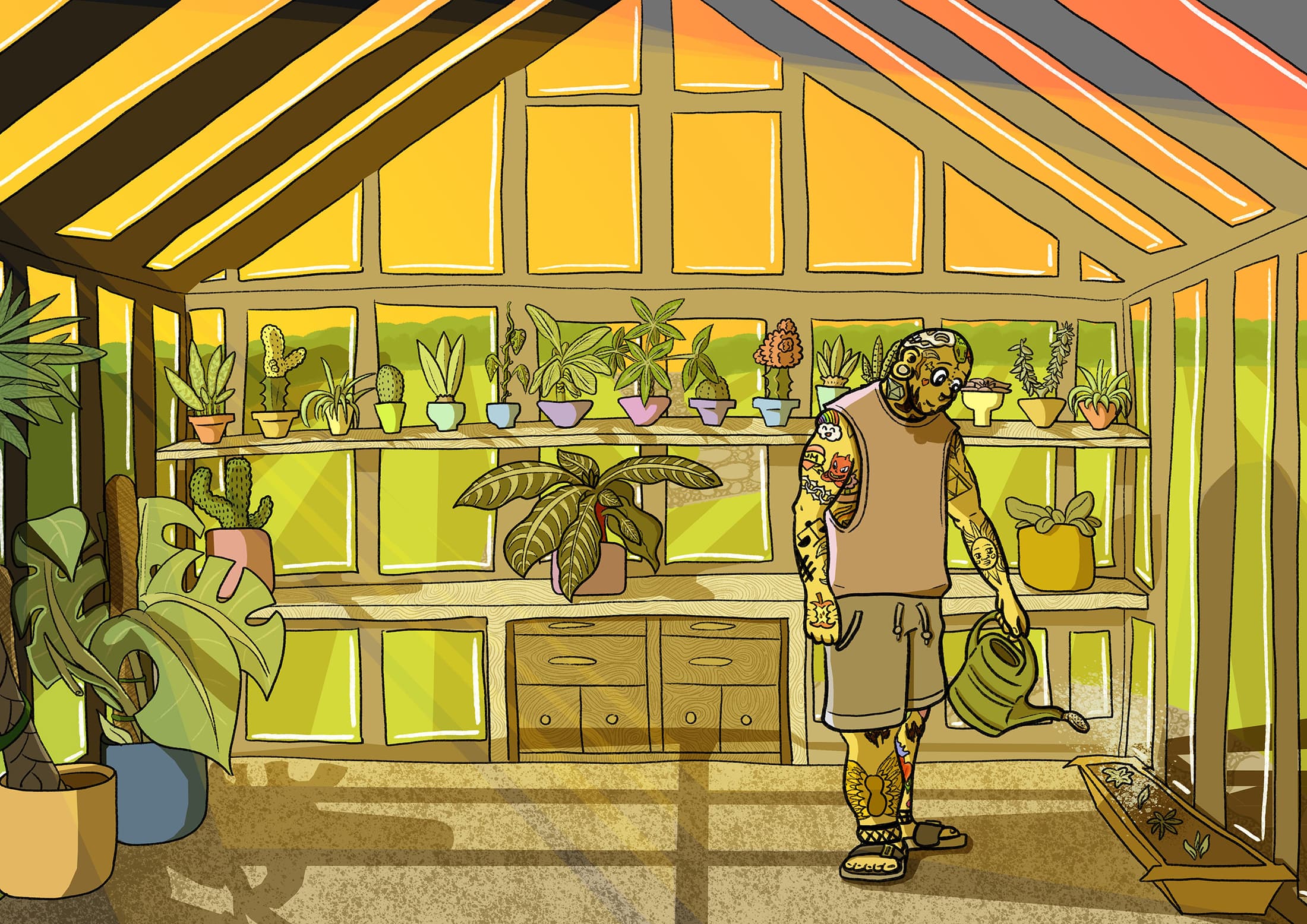
Sam describes himself as an artist focused on the mundane, everyday realities of trans life, moments that rarely make headlines.
“Trans life can be so incredibly boring,” he says. “We just want to pee in peace, pay our bills… and live a private life.”
His practice is driven by humanity, and a right to be left alone while still being seen. He is drawn to unglamorous rhythms of life: pottering in the garden, reading, caring for loved ones, navigating work, and finding pockets of joy in community.
Asked what is causing pressure right now, Sam says life isn’t always easy.
Government policy, EHRC guidance, trans segregation, the cost of living, and the challenge of finding time to create while working two jobs and caring for his partner, are elements he finds challenging.
Creativity and community
Alongside his creative work, Sam balances two jobs and caring responsibilities. He works full‑time in medical administration for GenderPlus, a CQC‑regulated private gender‑affirming healthcare pathway. “It’s really rewarding to be helping my own community,” he says. He also works as a Youth & Community Coordinator with X2Y Youth Charity, facilitating wellbeing‑focused activities for LGBTQIA+ young people and adults.
Professionally, he illustrates for LGBTQIA+ authors, takes on editorial and charity design work, and is currently illustrating a Trans & Gender Diverse Young People in Sports Community Toolkit funded by the University of Coventry.
“I need more time to be creative; I have so many ideas!” he says.
“I love what I do; however, I do wish I were living the artist life I always wanted. Maybe someday!”
What's next?
Sam keeps a list of creative achievements he hopes to complete before he turns 40. These include:
- A solo exhibition — working title Fat, Queer, Trans, Fabulous and Lonely (An SOS of Self) — exploring intersections of fatness, queerness, transness, fabulousness and loneliness.
- Writing and illustrating short stories, with hopes of publishing through a major house.
- Establishing an Arts Market for queer, trans and intersectional creatives, both locally and globally.
- Creating a dedicated queer and trans gallery space, with seasonal exhibitions.
- Running monthly community workshops.
- Beginning a PhD examining non‑verbal cues of consent in queer sex spaces and how these appear in visual art.
Finding inspiration
For Sam’s creative process, repetition, observation and emotion are what counts. A typical day involves working over a graphics tablet or drawing outdoors. He adds: “These drawings are never good and that’s okay!” Because they help with composition later.
He uses paper, digital tools and Copic brush pens. He recently moved from Adobe to Affinity because Adobe “became SO pushy with AI.”
Ideas often begin with “rage, frustration, or a single word,” though he has recently aimed more towards uplifting people. “There is so much to be upset and angry about in the world right now,” he says. “So, I’m focusing more on celebrating those who are doing good.”
Sam hopes his work brings understanding, empathy and representation.
For trans viewers: “I hope they feel represented, heard, understood and uplifted.”
And For others? “I hope they can learn… reflect… confront their own prejudices.”
So which art and culture does he admire right now? Sam is drawn to work mirroring politics and emotions, such as Evanescence’s Sanctuary, which explores “failings of Western governments, the rise of AI… grief and loneliness,” and Max Hovey’s No Fats, No Fems, which examines queer empathy and algorithmic bias.
He encourages emerging artists to find community offline, embrace tracing as a learning tool, and work a “normal” job for the skills it teaches.
His most urgent advice to emerging artists is characteristically direct as he hammers home his cautionary message: “Do not under any circumstances pay galleries to exhibit your work.”